
Edith Care does the heavy lifting on assessments, so professionals have more time for people
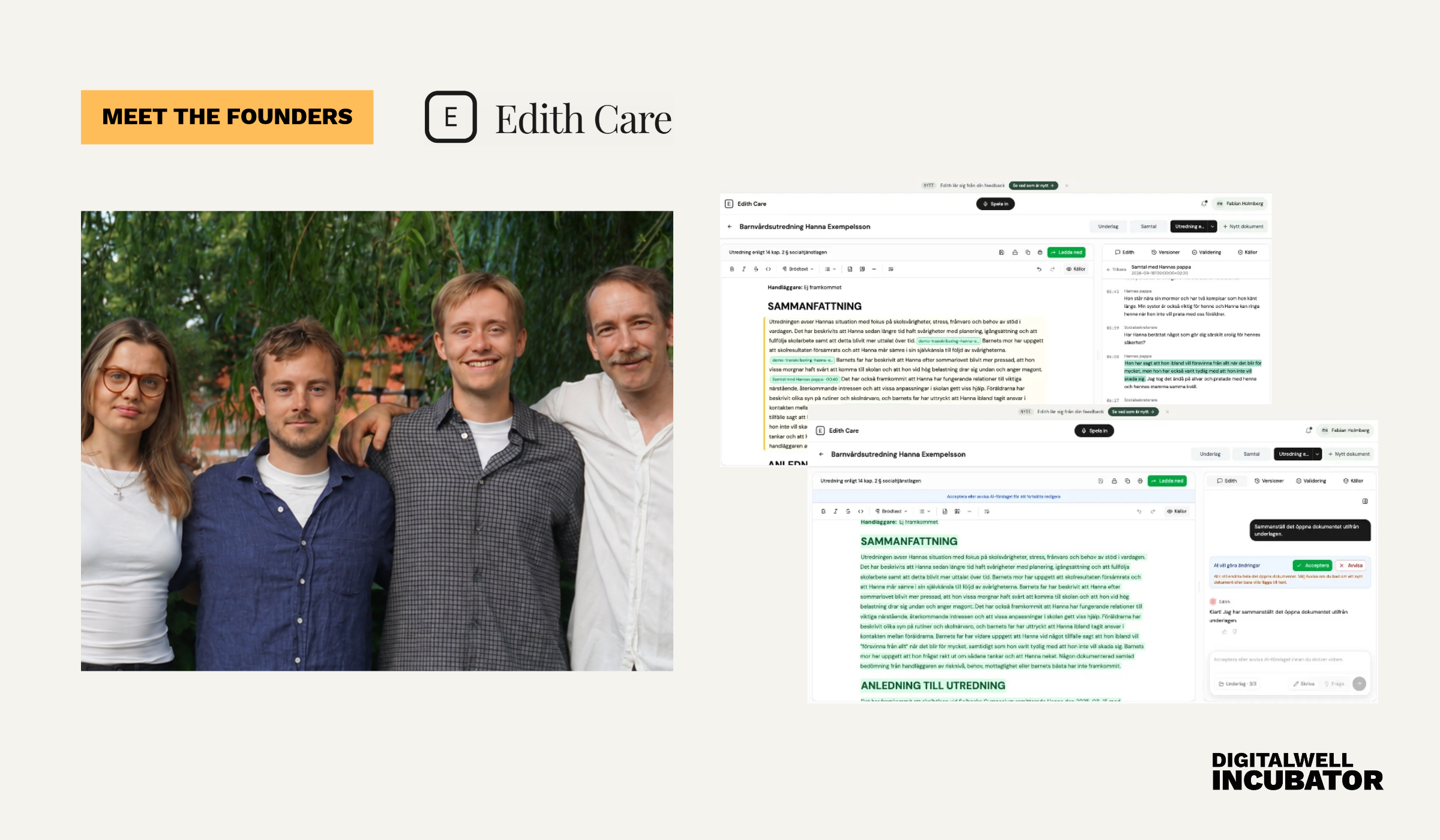
Social workers, psychologists and counselors spend much of their time reading, compiling and writing up assessments. Edith Care is an AI tool that produces a first draft for them, freeing up time for what only people can do: making the call and being there for the person in front of them.
In family law, an assessment could take months and fill as many as 40 pages. That was what co-founder Gustav Svensson heard from his mother over dinner. During her years in social services, she wrote every note herself in outdated word processors.
The conversation raised the question that became Edith Care: could Gustav build something to help her and everyone else doing the same job get it done in less time?
Where the time goes
In a neuropsychiatric assessment, the case material can be anywhere from 50 to 100 pages, according to co-founder Fredrik Gordh Riseby. Medical records, previous assessments, test results and interview notes all have to be read. Then everything has to fit under the right headings in the organization's template.
That last step takes the most time. In a survey Edith Care conducted among 75 psychologists, 64 percent named writing the report, the document that pulls all the material together, as the most time-consuming part. Far fewer pointed to clinical notes.
Swedish social services have known about the problem for years. Cecilia Grefve, the government's national coordinator for child and youth social services, measured working time in some 50 municipalities in 2015–2017. Social workers conducting investigations spent on average two percent of their time in one-to-one conversations with children and young people. That works out to roughly ten minutes a day with the children the entire investigation is about.
Edith writes, people decide
Professionals upload the case material to Edith: records, previous assessments, test results and notes. Conversations are transcribed in real time and the audio is deleted once the transcript is complete. Edith then sorts the information under the right headings in the organization's own template and produces a draft. Every section can be accepted, edited or rejected, but the judgment and reasoning stay with the professional.
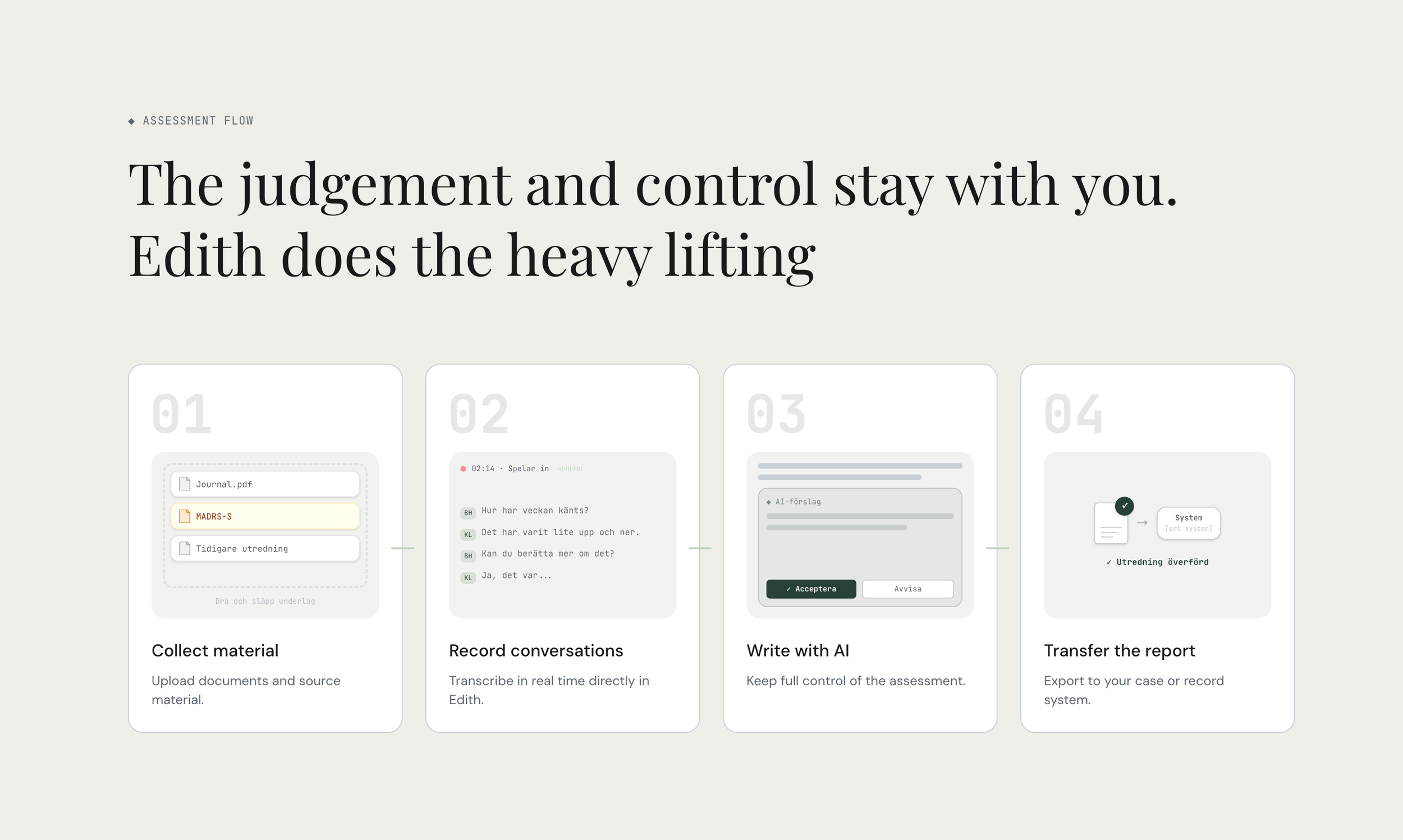
Image: Edith Care
According to the company's measurements at customer sites, assessments take roughly half the time with Edith. On the Swedish review site Reco, users in social services and psychiatry write that they have gained more time for clients and patients. One psychologist writes that the tool leaves more room for “reflection, analysis and professional judgment.”
All data is processed in Sweden and the AI runs in Swedish data centers. Edith works as a standalone tool and the company is in talks with several providers of records and case management systems about integrations.
Today, ten private neuropsychiatric clinics use Edith, as do the social services in Årjäng, a municipality in the Swedish region of Värmland. The pilot there also includes a series of AI training sessions. In Arvika, a pilot with the municipality's school health team is underway.
“Starting with a new tool can feel a bit scary and uncomfortable. We want to be the partner that takes municipalities by the hand and helps them over that hurdle,” says Fredrik.
Behind Edith are CEO Gustav Svensson and CTO Fredrik Gordh Riseby. They worked at the same IT consultancy but first met on a ski trip to Orsa. After a day on the cross-country trails, they talked about what they wanted to do next. Six months later, Gustav came to Fredrik with the idea for Edith and Fredrik was hooked right away:
“Building things and helping people is what has driven me all my life.”
Märta Norman joined early as founding engineer and leads the development of Edith. Psychologist Mattias Wretman, the company's clinical advisor, has ten years of experience in neuropsychiatry and school health services. Gustav's mother also advises the company, drawing on her years in social services. Between them, the team brings backgrounds from the Stockholm School of Economics, KTH Royal Institute of Technology and Linköping University.
Too busy to take help
The hardest part has been fitting into the workday of the people Edith is built for. Fredrik puts it this way:
“It's like a miner hacking away with a pickaxe. Someone comes along with a jackhammer, but the miner is so busy swinging the pickaxe there's no time to take it. That's roughly where things are right now.”
A new tool takes effort even when it saves time. Integrations follow the same logic: a municipality won't pay to connect Edith to its systems until it knows the tool is worth it, and it won't know that until after a pilot. That is why much of the work comes down to helping municipalities and regions see what Edith can do for them.
In March 2026, Edith Care joined DigitalWell Incubator. With an external business development advisor, the founders mapped how their customers buy and built a value-based pricing model. That work also gave them the market insight they needed to calculate how much capital the company requires. Through a seminar series in Arvika, they connected with the social services in Årjäng and the school health team in Arvika, now their two municipal pilots. Six months later, they also entered DigitalWell Accelerator, alongside DigitalWell Incubator.
Next: more municipalities
After Årjäng and Arvika, Edith Care is now in talks with several other municipalities in Värmland. Other organizations have also helped confirm the need, among them Region Östergötland, where psychologists in child and adolescent psychiatry and adult psychiatry took part. A quality review of the tool is due to be completed this fall. In November, Edith Care will pitch at Web Summit in Lisbon after advancing from the group stage of a competition.
The company is now looking for more municipalities and regions that want to use Edith in social services, school health services and psychiatry, as well as capital to grow.
“We want partners in every single municipality in Värmland. Together with them and municipalities across the rest of Sweden, we want to help as many people as possible,” says Fredrik.
Company: Edith Care (Jobello Technology AB)
Headquarters: Stockholm, Sweden
Founded: 2026
Founders: Gustav Svensson and Fredrik Gordh Riseby
Website: edithcare.se
LinkedIn: linkedin.com/company/edith-care
Looking for now: More municipalities and regions that want to use Edith in social services, school health services and psychiatry, plus capital to grow
Edith Care is part of DigitalWell Incubator, a program for companies in an early phase that are building digital solutions for the public sector in health, welfare and public services. It is open to companies based in Sweden and accepts applications on a rolling basis.